Lung busting, handlebar fighting, knee crunching. I can hear the ragged breath of the four riders behind me unable to get past on a track just wider than my bars. Brambles hang down from the trees ripping at arms and legs. A slippery, stone slithering, rocky path rising steeply through some alder, birch and sycamore woods. Pioneer trees on an industrial wasteland, the legacy of the wealth extracted from the hillside in the zenith of 19th century mining. The average angle is over 10% with steps of 16-18% and the rain of the last few days has slicked the surface and piled loose chips of rock just where you want your tyres to go forcing me into the eroded gully in the middle of the path. Welcome to the 2025 Mines and Mineral Railways off road audax.
There are two versions of this audax; on road for about 55k, a perambulation around mining villages, spoil heaps and quiet lanes. And the off road version where mountain bikes out number the gravel bikes as anyone who has done the ride before will know what is coming up.This is rough stuff riding, not gravel paths. Put your knobbly tyres on and be prepared for a short but intense ride over spoil heaps, along old railway tracks, past the decayed towers of mining engine houses, through scrubby woods still trying to grow on poisoned land and up some soaring lanes that will reveal sudden panoramas of coast and sea.

One hundred and fifty riders have set off on a variety of bikes including a substantial youth contingent from the Wheal Velocity club. Great to see youngsters as young as ten embracing audax. Quickly the riders split with the on road version heading north and the off road riders rattling down a wide track to join the coast to coast trail. Three kilometres to get warmed up and it all kicks off with a steep, rocky ascent to Unity Woods, a favourite mountain bike playground. The narrow track is difficult and narrow with frequent bends and quickly clogs up with riders. A chain reaction as someone ahead is forced to stop or skids backwards. Best to wait this one out and let the crowds move on.
The ride continues through woods, along field edges on well made tracks, joining up lanes and then along the old railway track to Portreath. You can still see the granite sleepers on which horse drawn wagons were pulled on iron rails, carrying coal from Portreath harbour one way and sending copper and tin the other way for the smelters and ship builders of South Wales. This was once the wealthiest part of Britain: now its just about the poorest.
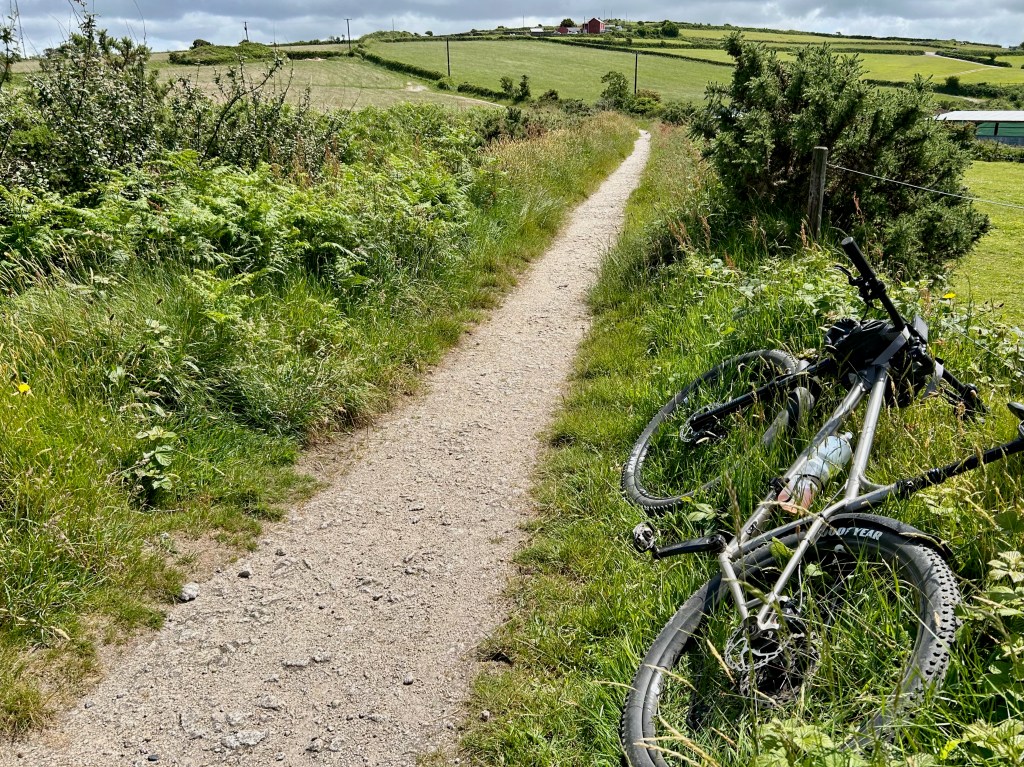
A long wooded section follows, passing knots of families out walking with disobedient dogs on broad tracks under oak and beech, until breaking out into open lanes with a widespread view to St Ives bay. The sea glinting dully under a leaden sky but still an inspiring sight with the green granite domes of Penwith behind. So far it has been easy riding and a chance to chat and watch the views unfold, letting the more competitive riders range further ahead. The countryside has to be left behind now as we head inland to the urban centres of the old mining district.
An awkward and complex route through Pool and Camborne passing old mine buildings mixed in with Victorian and modern terraces, the poverty of this part of Cornwall demonstrated by the paucity of shops and the frequency of abandoned cars. There are a number of steep hills but so far the ride is reasonable with only short sections of more technical path. That will change as we approach Carn Brea, the high granite whale back that dominates mid Cornwall with its iconic tower and mock castle visible for miles around.
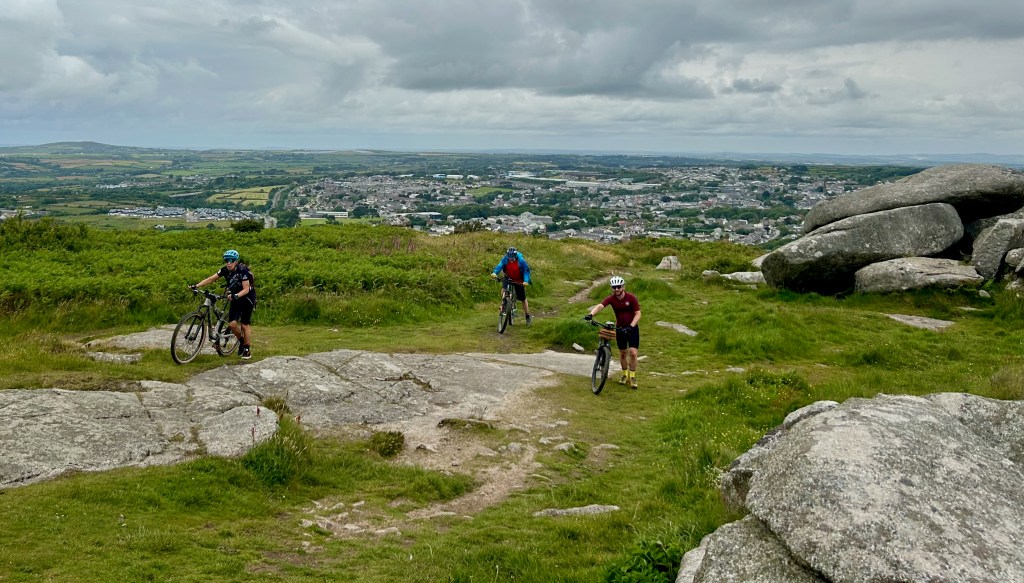
The track to the summit quickly moves from wide gravel to a difficult stepped path and only a few are capable of riding all the way. The views from the top stretch from coast to coast, especially if you climb up the pancake layers of granite around the summit tower. It could be Dartmoor or the Peak District, an open stretch of bracken and gorse with rocky outcrops or tors and between us and the sea, the rambling, chaotic Camborne-Pool-Redruth urban landscape with old mine workings, tips, industrial estates and houses jumbled together.
It is down that open moor that we must go next following a faint path through chest high bracken that cuts down steeply with some short rocky drops punctuating the handlebar wide narrow gravel track. A breathless adrenalin rush if you take your hands off the brakes but the consequences of an error are a thorny tumble into the gorse and brambles.

At this point it is clear from talking to others that there are many of us who have taken alternative routes already today. The different paths make a complex web across the hillsides with too many options and it is not always clear where to go as the GPX track is often twenty or thirty metres from the actual path. I am also guilty here of going off route as I continue the downhill run from Carn Brea, missing my turning and having to add a loop of road and track to regain the route.
Two more steep hills, comfortable, if heart pumping and breath shortening riding along good gravel tracks built to take miners and wagons to the mine works whose chimneys and engine houses punctuate the skyline in every direction. The last hill of this loop is Carn Marth and the views from here cover much of the old mining district. You can see the marching lines of old mine works, the chimneys and engine houses following the flat lode of copper and tin, making an orderly procession of monuments as impressive as any prehistoric line of standing stones. This is a world heritage site and you can see why.

Take a breath here and admire the views for a moment because although the descent initially follows a fast and wide gravel track down hill, it will soon turn into a blind dive on a narrow bridleway where the bracken and brambles and stunted trees are above head height, crowding the path and leaving a space narrower than my bars. I have to hold the bars inside the brake levers to avoid being slashed at by thorns and briars, watching for the frequent short, rough drops and the larger rocks, grateful for front suspension. Gravel bikes are coming down too but they show a skill beyond mine in jumping down the drops and swerving the rocks littering the path. It is fast riding downhill – as long as you concentrate.
Fifty kilometres of riding and the first loop terminates at the start point in the Miner’s Hall at Carharrack. A fitting place to start and finish this ride, which explores the rich history and geology of the mining district. For those less inclined to industrial archeology there are pasties and cakes and hot drinks here too, a chance to sit and contemplate what is to come and more than a few decide that the first loop was enough at this point.
The second loop is shorter at fifteen kilometres but it packs in excitement all the way. It is substantially harder than the first loop with a very tough ascent up the Bissoe valley at its steepest, then deep rutted and very muddy bridleways and a final precipitous descent following a tenuous line of possibility through a thicket of bramble and hawthorn.
Time to leave, the pasty just what I needed and if I hang around much longer I will get stiff and cold.
There are riders all over the place as we all follow what we think is the best path or even the correct path across a wasteland of spoil heaps, mine workings and eroded gullies. The GPX track is suspended in mid air as far as I can see, levitating an imaginary route some thirty metres beyond a steep drop. Riders stop and question their choices of route, some following me for a while and then peeling off on what they consider to be a better choice. There are a myriad of tracks crunching through mine spoil, the land still too poisoned with cyanide and lead to allow any sign of plant growth even now a hundred years later. People living in this valley have to grow vegetables in raised beds on imported soil lest they poison themselves.

My route becomes hazardous as I follow a narrow ledge suspended between a hundred foot drop away to my left, a chaos of gullies, loose rock and capped mine shafts, and on the right a tall fence designed I suspect to stop people going off this edge. But only if they are the other side of it which I am not. The path crumbles beneath my wheels, stones sliding downhill and I hold my breath for the next twenty metres before being able to cross the fence and head on a better track down the hillside to the bottom of the Bissoe valley. That was certainly not the official route.
Down to the valley floor and then up the other side, a horrible, steep, knee popping scramble up a loose gullied track through scrubby woodland before entering the muddy bridleways at the top. A change of pace follows; we move from scrabbly gravel and rock paths to very muddy but mercifully flat tracks through woodland. The back wheel squirms in the deep mud and puddles and trees and brambles encroach on either side forcing you to take the deepest ruts and through the worst puddles. This is no fun, not a technical exercise but a brutal stomp through sticky mud, the wheels throwing clods of it over my head and my legs now well spattered.

The worst is yet to come. The final descent, that will lead to easier tracks and then it’s just five kilometres to the finish. Last year I avoided this descent and took a lane to its left but this year I am determined to do it properly. I have met up with club mates at this point, more experienced than me, who correctly recoil at the sight of a very narrow path disappearing into a kilometre long thicket of bramble, gorse and blackthorn. They head for the lane.
I ask ‘how hard can it be’ and launch myself down, barely able to see the rocky steps, gullies and bigger rocks and for the first time today having to drop the saddle to retain any sense of control. I am not in control, just hurtling past brambles and blackthorns that slash at my legs and arms. Blood erupts and the stinging nettles bite at the remaining flesh. The back wheel locks up, sliding down a steep spit of loose rock and I narrowly avoid sliding into the stream. The descent seems endless, my view restricted to just a few metres of foliage and glimpses of a water worn path. I am hugely grateful to reach the bottom, trailing ribbons of flesh, heart pumping with adrenalin. Later at the finish I can see who else took that final run through the thicket as we share blood stained forearms and deeply scratched legs. I will not do it again next year.

An interesting day out; six hours to do sixty five kilometres. Not the same as any other audax I have done and hard to compare with a summer ride on rolling lanes that may deplete my reserves of strength and energy but do not offer the opportunity to slide uncontrolled down a spoil heap or take battle with briars and thorn. Huge kudos to the gravel bike riders that finished the second loop too. Many thanks as ever to the enthusiastic organisers who made it all happen – one of the more unique audaxes and an interesting excursion into the world of rough stuff riding. Living life to the full over sixty five kilometres of post industrial Cornwall.

 theanxiouscyclist
Leave a comment